|
|
|
|
|
Aston Village History Book Series No. 2
ASTON Jack Pallett's Memories and the Village History
is available from desturner@aol.com
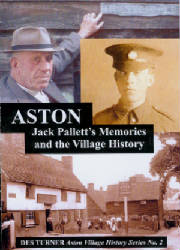
The book is mainly an oral history containing the memories of Jack Pallett, 1896 – 1975, who apart from serving King
and country in the First World War, lived most of his life in Aston. He was the last villager to speak the pure Hertfordshire
dialect. Des has recorded his memories as spoken so those who knew Jack can hear him speaking as they read. For instance Jack
recalls: "You could go in the Bee Hive and ’ave a pint a beer, a box a matches and five Woodbines and put sixpence
on the counter and they’d give you a a’penny change."
His memories begin with his family who ran the Post Office, The Boot and Rose and Crown public houses. The
Pallett’s trades and skills were varied, builder, carpenter, wheelwright, undertaker, coffin maker, sexton, butcher,
postmaster and grocer, etc. Jack remembers: "My father ’as made a coffin, dug the grave and buried a child for five
shillings." Jack even had an Aston ancestor, William Pallett, who fought at the battle of Trafalgar on HMS Bellerophon,
known to the crew as the ‘Billy Ruffian’. The Palletts owned property and land in the village, two
pieces of which were compulsorily purchased to build council houses and garages in Stringer’s Lane. Sadly the latter
involved the demolition of a very attractive thatched timber framed cottage. He takes us back to a village of horse drawn
carts and carriages when Aston had its own wheelwright, farrier and blacksmith. Most men worked on the land. Women were employed
in service at the larger houses, others took in washing and helped as midwives. "If a woman was gonna to ’ave a baby,
they would argue who was gonna to look after ’er."
Food was scarce and most villagers were very poor. Drinking water was pumped from deep wells or collected at the natural
spring. There was no electricity and no piped sewerage disposal. This close and caring community supported each other with
help friendship, advice and a packet of tea when needed. The local school taught the three R’s and strict discipline
was asserted by the constant threat of the cane but the children respected and liked their teachers.
One of the men’s past times was ‘Bat Folding’ (catching sparrows in a net fixed to poles), and there
were so many birds that Sparrow, Thrush and also Blackbird pie were often on the menu. "If you let it get cold it sets
like jelly, they are lovely."
The Great War was an utterly devastating blow to families who lost young sons and it took others away from home for up
to four years. Unusually for a war veteran, Jack, whose younger brother Edwin was killed in France, talks of his own harrowing
experiences at the battlefront. He served with the 2nd Battalion East Surrey and was in the second battle of Ypres,
the battle for Hill 60 and at Loos. Twice he suffered the effects of gas attacks. "We laid in the bottom of the trenches
like anybody with asthma. The bolt of your rifle and your bayonet was the colour of gold, with this gas."
He was then sent with the Division to Salonica and fought in Greece. "If I ’ad to goo through that ag’in,
if I knew I was coming ’ome safe, I’d rather stand up ag’in a wall and be shot."
At home, a German Zeppelin passed low over Aston on its way to bomb London and locals witnessed it being shot down in the
distance. "The blazing mass began to fall perpendicularly and broke into two pieces…."
The second part of the book is a general history of Aston and contains many interesting facts and events. For instance:
In 1598 Margaret Daye, Agnes Brisley and Joan Smyth spinsters of Aston were indicted for burglary. ‘They burgled
the house of George Kytchyn at Aston and stole a cloth gown – value 40 shillings, 16 lbs of butter – value five
shillings, a brass kettle – value five shillings and three yards of russet cloth – value 26 shillings. Guilty;
Daye and Smyth to hang, Brisley remanded because pregnant.’
A cottage in Aston in 1691 could not be saved. The dwelling of John Featherstone, basket maker, with shop, goods and gleaning
corn, went up in one roaring combustion; a poor innocent child of six years of age was also consumed, to the astonishment
ruine and utter undoing of the said Featherstone. Seven years afterwards the unfortunate John along with his wife and two
children was still homeless and in receipt of two shillings a week from the overseers of the poor.
This new paperback book is size A5. It comprises 80 pages of text and 86 rare photographs collected by Des over a forty-year
period. The price is £10.00 plus post and packing obtainable from desturner@aol.com
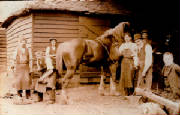
|
| ASTON FORGE Left to right: Will Wright, Bert Wright, , ?, Arthur Acres and owner Robert A. Wright. |
Both these pictures are included in the book.
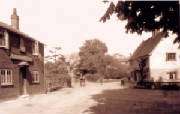
|
| CENTRE OF VILLAGE Bee Hive Pub on left and Jack Pallet's cottage on right. |
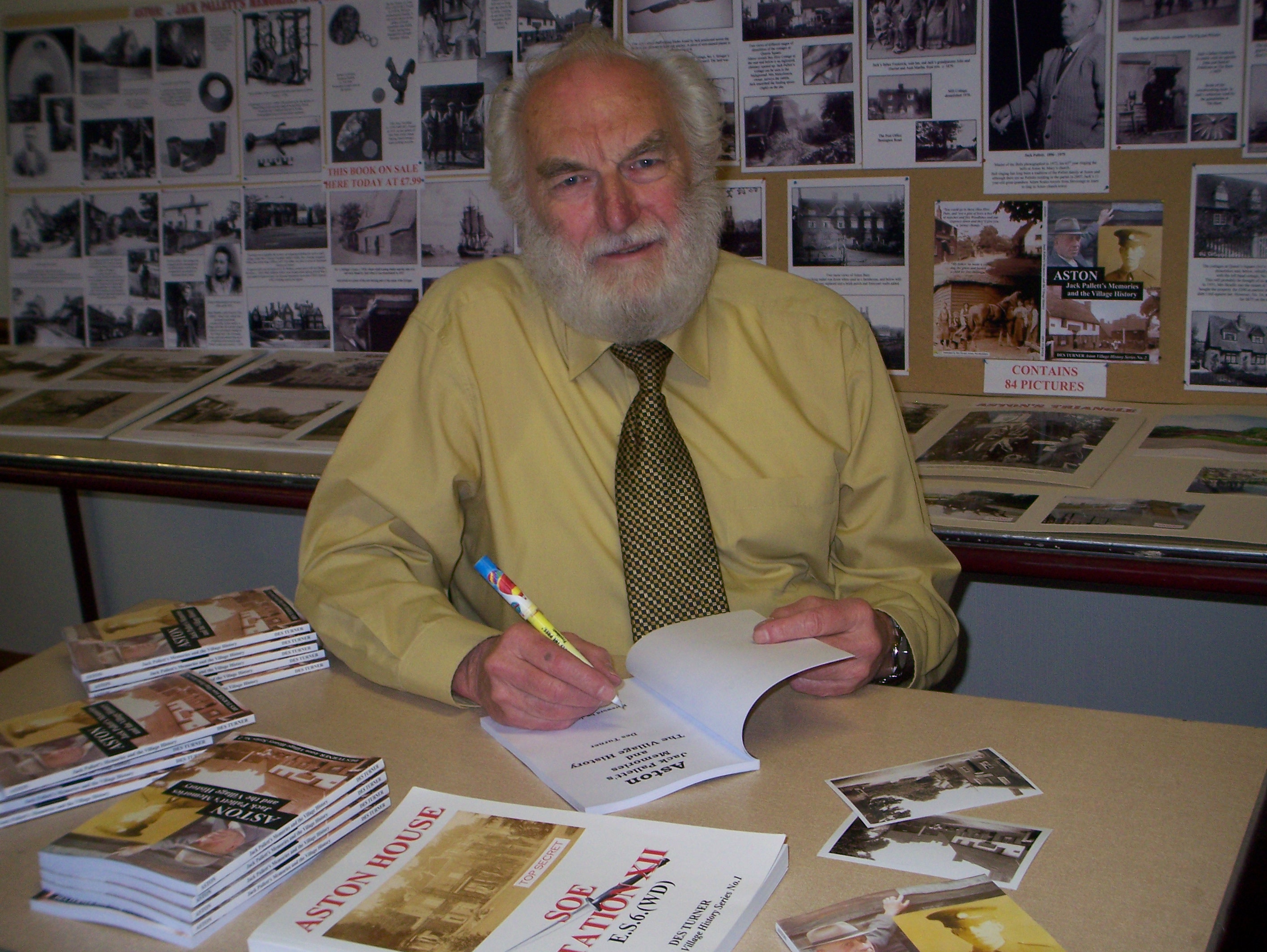
|
| DES at Aston book signing surrounded by pictures that appear in the book. |
WELCOME TO ASTON!
|
|
|
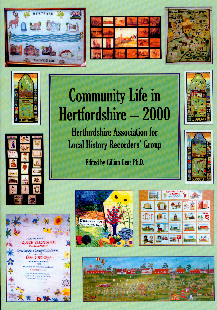
IT'S PUBLISHED!
Yes! 'COMMUNITY LIFE IN HERTFORDSHIRE- 2000'
was launched on 17 November 2001 at Herts. Archives and Local Studies, County Hall, Hertford.
Edited by Gillian Gear Ph.D. Price ten pounds. If you experience any problems in obtaining a copy, contact HALC by e
mail: hertsdirect@hertscc.gov.uk
My name is Des Turner, Aston's official recorder for the HERTFORDSHIRE ASSOCIATION FOR LOCAL HISTORY RECORDER SCHEME. (Now
defunct)
The above association has published a book containing a record of Hertfordshire's Millennium Celebrations. Every town
and village was invited to contribute a pocket history and description of the activities that took place in their locality
to celebrate the new millennium.
Aston's contribution is below. I would like to thank Ian Campbell, Gary Holt and Margaret Moreham for their help with
details of their Aston Millennium Events.
ASTON by Des Turner
During the first half of the last century Aston changed very little. It was a typical Hertfordshire village, quiet, remote,
approached by narrow country lanes. Perched on a hill between two valleys with the River Beane on its eastern boundary, surrounded
by meadows full of wild flowers and birdsong. At its centre a group of attractive cottages, barns, three pubs, a post office/shop,
a farrier/blacksmith and a carpenter/wheelwrights shop.
Spiritual and educational needs were catered for by the church, a mission and a church school. The hamlets of Aston End
and Hooks Cross combined within the parish to make up a steady population of less than 600 It was mainly a farming community
with four large country houses and their respective estates. The latter providing work for domestic staff. There was no mains
water, electricity gas or piped sewerage disposal. Transport for the poor was Shank's Pony. Villagers walked to Stevenage,
Hitchin or Hertford to make special purchases. Most produced their own food by growing vegetables and keeping livestock. An
extremely close and caring society.
The first world war took away the lives of 17of Aston's young sons.
World War II brought the war to the village, when Aston House became Station XII of the (SOE) Special Operations Executive,
responsible for special weapons and explosive devices and Frogmore Farm was taken over as SOE's Station 18 a Holding Station
for the Polish Cichociemni (Agents). Frogmore Hall was also used by the Poles and it was also a training base for British
Military Police.
Since the war, change has accelerated dramatically. As the army and military hardware moved out, Irish labourers and the
Stevenage Development Corporation moved in. Aston House became its HQ. The beautiful countryside on Aston's western and northern
flanks disappeared under the concrete of Stevenage New Town. Then parts of the parish met the same fate. New housing developments
also took place within Aston's shrinking boundaries. Cottages were gradually purchased and modernised by commuters. The population
almost doubled.
Those among the new influx of people who were environmentally sympathetic joined with remaining villagers to help protect
and improve life in Aston. Together they formed an amenity society, became members of the parish and church councils, raised
funds to build a new school and demolish the existing Victorian school and parish room. Land was acquired for sports activities
and the building of a village hall. Many clubs and groups were formed and a children's play area created.
Pressure from developers resulted in a deal to save a field in the centre of the village in exchange for green belt land
next to the church. This centre field is now the cricket ground. It forms a major part of the village open area.
Campaigns against Stevenage expansion and protection of the green belt have been vigorously pursued. The village remains
under constant pressure from planners and building speculators.
Workers now commute to the village, as farmers who are encouraged to produce less, let their buildings as small business
parks. Of the remaining large old country houses, one incorporates a business office, the others, including Grade 1 listed
Aston Bury and its ancient barn, are divided into separate dwellings. Aston House was demolished along with the wartime buildings
and houses were built in their place when the Stevenage Development Corporation moved out.
There are four almshouses, a gift from a local hay and straw merchant. The lanes are wider now due to constant traffic
erosion of the banks. The east/west route through the centre of the village has become a dangerous 'rat-run' as traffic passes
through. Changes to the road network removed a very attractive triangular grass covered island opposite the war memorial that
did little to slow traffic down.
The river Beane, a valuable chalk stream is dry for most of the year. The bird population is at an all time low. Wildflowers
however are slowly coming back. An annual Aston Fun Day attracted visitors from Stevenage for a few years and while provided
funds for village organisations and the upkeep of the village hall. One of Aston's pubs survives and one at Aston End. A car
is essential as buses are few. The single most damaging blow to the social aspect of the community was the closing of its
post office and village store. The school remains open but some 75% of the children are from outside the parish. The water
tower no longer contains water but has become a mobile phone mast. It was sold in 2019 for possible conversion to a dwelling.
With the loss of the public house, shop and post office, each of them essential to support a village community, Aston
has become virtually non functional, especially for the elderly. Families that frequented the village by walking up from
Stevenage to enjoy an ice cream at the shop or a pint at the pub no longer appear. The village centre has effectively died.
A futuristic new home has been built in the central conservation area ruining the visual aspect of what, surely, we all expect
a Hertfordshire village to look like?
BONFIRE AND FIREWORK CELEBRATION (By Ian Campbell)
At midnight the church bells rang out loud and clear, fireworks climbed high into the sky, bursting in a profusion of
tiny stars lighting up the night. A bonfire blazed as villagers turned out in force on centre field to mark the arrival of
a new Millennium.and was sold in 2019
There could not have been a better start to the year 2000. Even the rain, which had threatened for most of the night,
kept off until after the firework display.
Mulled wine was dispensed at the cricket pavilion and a most enjoyable New Millennium Celebration was had by all.
NEW YEAR'S DAY FUN RUN AND WALK (By Gary Holt)
A beautiful sunny Sunday morning enticed over 200 villagers and friends to enter the tenth annual, three mile long, Fun
Run and Walk. A special Millennium commemorative medal was sponsored by Aston based companies.
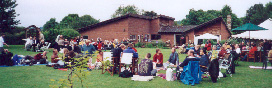
MIDSUMMER MILLENNIUM EXPERIENCE (By Ian Campbell)
The 24th June was the nearest Saturday to Midsummer's Day and should theoretically have afforded the best opportunity
for a balmy summer night's entertainment in the garden of Ruth and Bernie Biggs. The music by local Rock group, 'The Egg and
Bacon Band' and Bernie's own 'Main Avenue Jazz Band', was superb.
The bands each played two sets between 7 and 11pm. The weather was somewhat chilly, but no rain. A magnificent enthusiastic
audience of some 300 villagers of all ages wholeheartedly entered into the spirit of the evening. They brought their own picnics,
liquid refreshment and chairs and tables, thus generating a grand, 'British summer outdoor venue', atmosphere.
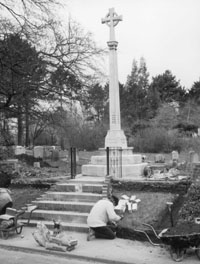
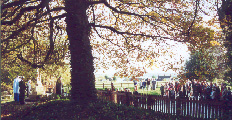
WAR MEMORIAL REFURBISHMENT & VILLAGE SIGN
A millennium committee was formed under the chairmanship of Brian
Richardson
to refurbish the war memorial and organise a competition
to design a village sign.
Financial support for the
£13,800 project was given by village
organisations, businesses and individuals and a grant was received
from
the Hertfordshire Environmental Landfill Project (HELP).
The memorial stonework was cleaned and repaired, new wrought
iron
railings installed, brick steps replaced and new side panels of
Hertfordshire cobbles constructed.
VILLAGE SIGN
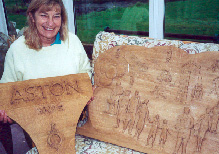
The village sign competition was won by Margaret Moreham. Carved in oak, the sign depicts the people
and organisations of Aston in the year 2000, working and playing together for the good of the village. It will be erected
in the spring of 2001.
TREE PLANTING
Aston Village Society produced a souvenir Millennium issue of the Village Directory, recording village achievements and
some historical facts. The society also undertook the planting of over 200 trees thanks to a grant by Hert's Countryside Management.
Most were for hedgerow reinforcement at the school but one special decorative thorn, 'Paul's Scarlet' was designated the 'Aston
Millennium Tree'. And will be planted in the churchyard.
Picture credits: Midsummer Millennium experience at
Bernie Biggs- Ian Campbell and Des Turner
Updated: 08/06/2020
|
|
|
|
|